Blog

Run From Doncrow: A Beautiful Books Linkup

medieval

Hello, I’m back.

This October definitely did not go the way I thought it was going to go.

I sprained my ankle playing football (can you guys even see me playing football?) which sidelined me for almost two weeks. And of course my two jobs are on-your-feet-walk-around-and-haul-stuff jobs, so I couldn’t work, couldn’t drive, nothing.

“Great!” you say. “You can write and read and do blog posts!” Eheheh. My laptop is currently an invalid too, which means it stayed downstairs and I stayed upstairs. I wrote in a notebook. Watched some movies. And read books. And took lots of naps. (Oh, and for all you period drama fans, I watched Jane Eyre and Sense and Sensibility and had a blast watching people sprain their ankles.)

But I didn’t come to talk about injuries, or ankles, or naps. Because there is A Certain Event that started on November 1st, and of course, since I love November, and I love novels, I love this Event.

You all know what I’m talking about: National Novel Writing Month. In the month of November thousands of writers attempt to “win” NaNoWriMo by writing a 50,000 word novel in 30 days.

And this will be my third year.

In celebration of this (and also because I have been frightfully scanty with my writing recently) I have joined in the Beautiful Books linkup  run by the extraordinary Sky and Cait.


  • What inspired the idea for your novel, and how long have you had the idea?

A friend of mine was teaching a session at a conference a couple years ago. I had one of those speaker feedback forms and (I promise I wasn’t bored!) I filled it out as if I was listening to someone giving a talk on escaping a city. The fictional speaker did not know much, I recall, but the point was very clear—at all costs, if you get out, do not stop, do not look back, run. It was dystopian, and it dropped in my lap.

  • Describe what your novel is about!

Run From Doncrow

There are two things that are as important as life to nineteen year-old Leslie: his acting fame on Doncrow’s West End, which keeps him from the work gangs, and his sister, whom he hides to keep out of a slavery like his own. But when a long-lost friend shows up at his doorstep claiming to have found a city of freedom, he (and the lower class of the city of Doncrow with him) begin to dare to dream of escape.

Middle ground is fast slipping away—the dying underground resistance is reviving, the police force retaliating with cruel measures, and there are whispers of an upper-class man organizing escapes from closed Doncrow. However, for Leslie there is a new challenge: he is approached by the chief of the secret police, who wants to use him to spy on the resistance.

As Leslie’s life threatens to turn upside down, he must decide which he values more: security or freedom.

So look for a dystopian book full of dark, dirty streets, spies, loyalty and betrayal, knives under coats, roaring crowds and roses, tears in the rain, hot street pies, and bloody knuckles.

  • What is your book’s aesthetic? Use words or photos or whatever you like!
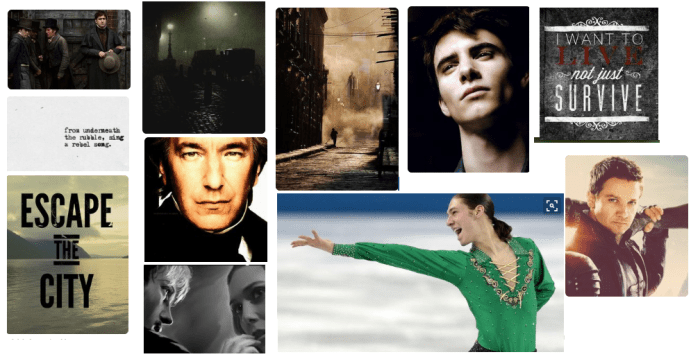
runfrom

  • Introduce us to each of your characters!

Leslie my MC is a slave, but he works as an actor. He is currently the toast of Doncrow’s West End, and extremely popular. He uses the gifts and flowers he gets from his adoring fans (the one thing he is allowed to keep for himself) to keep his sister fed and out of the work camps.

His sister, Althea, is about fifteen and in delicate health. However, she has a heart of fire for the underground resistance, and despite her brother’s protests, risks herself to aid its efforts.

Alexander Hampton is a wealthy man in Doncrow’s high society with close connections to the current ruling regime. However, he is secretly funneling funds to the underground resistance and organizing escapes from the city.

Judson is the only man to have ever reached LSI (the code name for the free city) and returned to Doncrow, making him the most wanted man in the city. In his death or survival hangs the fate of Doncrow.

Rosie is Judson’s fiancée, whom he promised to come back for. But now that her love holds such vital information, she must fight to keep him out of the clutches of the secret police.

Elias is the newly-appointed head of the underground resistance. Not much over twenty, he has been gun-toting for the resistance since he was seven, when his family was killed before his eyes. He is just and kind, but hard. And of course there are more, but that’ll have to be all for now!

Ernest is the chief of the secret police, bent on the arrest of Judson, Elias, and anyone in connection with the resistance or the black market. He is known for his heartless cruelty, his doggedness, and his habit of carrying peppermints for children, for whom he has a soft spot.

  • How do you prepare to write? (Outline, research, stocking up on chocolate, howling, etc.?)

I try to feel out each character, and without delving too deeply (half the attraction is some mystery) figure out their priorities, quirks, and what makes them tick. I usually have a Pinterest board or a collection of pictures that gives me the right impression, and a playlist, because musical association factors a lot in my inspiration. Then I usually find a “patron snack” for my story—a food I’m craving or that will support my story’s impression—and stock up, making sure there’s coffee, cocoa, etc. in the house. Then I pray, get very excited, and write.

  • What are you most looking forward to about this novel?

My characters! These people are what get me to sit down at the computer every day; they are what make this project worth the headache; they are the ones who inspire me with their courage and daring.That and the novelty of this project. Dickens’ London in a dystopian setting just gets me excited, and I can’t wait to explore the plot and worldbuilding that comes with it.

  • List 3 things about your novel’s setting.

There is an old rickety house where my protagonist lives, full of broken tiles, sagging shutters and holes in the stairs.

There is a huge mill in the center of the city where the worst criminals and members of the resistance are sent. It is surrounded by a tall fence with guards, and constantly belching smoke. Few people ever return after going in there, and rumors abound as to what goes on inside.

The city of Doncrow is like a dystopian version of London in Charles Dickens’ day. There are better parts of town where people live lavish lives, and then there are children starving in the street.

  • What’s your character’s goal and who (or what) stands in the way?

His goal is for his sister and himself to survive, and ultimately to be free. A lot stands in his way—he is another man’s property, his sister is at risk of discovery every day, and with the hope of reaching a free city comes the danger of being caught. The main person who stands in his way is Ernest, the chief of the secret police.

  • How does your protagonist change by the end of the novel?

He grows braver; he learns to live, not just survive; and he learns to value others’ freedom over his own.

  • What are your book’s themes? How do you want readers to feel when the story is over?

Standing for right even when it is hard or there are terrible consequences. Freedom. Rising above fear. Sacrifice.

I want my readers to feel braver when they are finished. I want them to have learned from my characters’ good and bad and gray choices, and I want them to be strengthened in their resolve to stand against wrong. And I want them to feel like they want to read the sequel. 🙂

Are you participating in NaNoWriMo? What are your favorite things about it?

A Time to Speak

a-time-to-speak

At long last, here is the review! Between starting a new job and attending a writers’ conference last week, plus editing, I found myself with significantly less time on my hands than I thought I’d have. Anyway….

The verdict: I LOVED it. Whatever little bits didn’t click for me in the first book clicked in this book and I could not put it down. But I’m getting ahead of myself. Here’s the official synopsis for starters.


What happens when you live longer than you wanted to? Parvin Blackwater wanted to die, but now she’s being called to be a leader. The only problem is, no one wants to follow. The Council is using Jude’s Clock-matching invention to force “new-and-improved” Clocks on the public. Those who can’t afford one are packed into boxcars like cattle and used for the Council’s purposes. Parvin and Solomon team up to rescue the people. Instead, they find themselves on a cargo ship of Radicals headed out to sea. What will the Council do to them? And why are people suddenly dying before their Clocks have zeroed-out?


My thoughts (let’s see if we can do this without spoilers):

Parvin: Unlike some series, it’s not just the protagonist’s circumstances that are changing—she is changing. Parvin is making a conscious effort to do what is right and you see the difference. She is still the same person, but her attitudes and actions are changing to fit her beliefs and I really like that.

Solomon Hawke: When I read the first book I thought perhaps he was my favorite. He is definitely my favorite now. Ack, he’s so cool!

The settings were awesome (and diverse!). You could really feel them, especially the cold place. But I won’t go in too much more detail because spoilers.

There was a lot of suffering, and there were even a few slightly gory things, but even so, I felt less affected by it than in the first book. Maybe Parvin’s attitude changed? Maybe it was because she felt more hope? I don’t really know, I can’t put my finger on why. Anyone else feel that way?

Another thing I liked about this book is that while people were in mortal danger (and some died), this was not a let’s-see-how-many-people-we-can-pop-off fest. She treated the characters with respect, and none of the deaths seemed extraneous. Kudos.

The author did a fantastic job keeping realism and hope well matched. Yes, things were bad—yes, they were awful, even. But through it Parvin was gaining an eternal perspective, and what many people forget in books is that there is a God and there is ultimately victory, whatever role you play.

The worldbuilding was another thing I loved in this book. The author did a great job of weaving together multiple cultures, each with its own assumptions, expectations, prejudices, and normalities.

My favorite line in the whole book? “I hope your potato tasted better than mine.” If you don’t know, then—well, I won’t tell you! Heehee. You’d better read the book.


The third book in the series releases tomorrow, so go out and show Nadine Brandes some readers’ love!

Have you read any of the Out of Time Series? What did you think?


Fall TBR

falltbr

Since September began, I have been having a little tussle with myself about fall. Half of me is super excited for the cool weather, for bright leaves, pumpkins, and cider and doughnuts, and the other half dreads winter on the other end of this (very) short season.

But one thing I haven’t had any problems with is putting together my fall TBR. It’s not too soon for that! Most of my summer was taken up with reading YA to get a feel for the current market and the genre as it stands right now (sorry to say, I was mostly unimpressed, but maybe that’s a post for another time), so I’m rather ready for a change.

How about some classics?


Sense and Sensibility by Jane Austen: Because I love Jane Austen, and I LOVE Emma Thompson’s adaption, and I haven’t gotten around to reading the real deal yet.

A Tale of Two Cities by Charles Dickens: Finishing this up from this summer. Somehow I just fell off halfway through and never got back on, even though I was enjoying it.

Jane Eyre by Charlotte Bronte: This is one my mom loves, and so even though I know the general storyline already, I have picked it up to read it in its entirety.

A Time to Speak by Nadine Brandes: I’m in the middle of this one, and I intend to be caught up and ready for the third book when it comes out.

A Time to Rise by Nadine Brandes: Coming out in October (so excited!). Support your favorite authors. Enough said.

I, Juan de Pareja by Elizabeth Barton de Trevino: This has literally been on my shelf for almost my whole life and my sister has been telling me I should read it for the last ten years. I suppose it’s been long enough.

None Like Him by Jen Wilkin: A wonderful study on the character of God. I’ve been using it sort of like a daily devotional…the chapters are a manageable size.

The Light Beyond the Forest by Rosemary Sutcliff: The search for the Holy Grail, beautifully and artfully done. Sutcliff knows how to handle legend.

Various works of C.S Lewis: I haven’t quite decided which to start with (I will accept recommendations), but I realized that I haven’t read much of his non-fiction and I haven’t read his space trilogy. So I’m going to remedy that.

Have you read any of these books? What did you think of them? What is on YOUR fall reading list?

Also, don’t forget the giveaway is closing at midnight tonight, so make sure you enter before it closes!

A Quiet Celebration

a-quiet-celebration

The Herosinger blog marked its first year in August, and what a year it has been!

I want, first off, to say a huge thank you to everyone who has followed, who has commented, who has reached out and been friendly—you are the best. I have so loved hearing your opinions, getting to know you, reading books you’ve recommended, and visiting your blogs. You are what make this blog worth it.

My ideal way to celebrate would be to meet with you all on a quiet rainy afternoon and chat over a latte, but since I can’t have that, I have come up with some fun questions (call it a tag if you like) that I would love for you to answer! Feel free to do so on your blog, or in the comments, or even, if you prefer, in an email.

And, because it’s a party and I can’t actually invite all of you wonderful readers to have a cuppa and cake with me, I am giving away a $15 gift card to Amazon for a book or two of your choice. (I think books are a moderately decent substitution, yes?)

Without further ado, here are the questions:

Three things that bring out the “inner geek” in you?

What’s the craziest thing you have done that you haven’t regretted?

Would you rather spend a day stuck on a rollercoaster or in a submarine?

If you had a theme song, what would it be?

What is the strangest character you have ever read or written?

What is the weirdest thing you have ever done in the name of reading or writing?

If you could undo one character death in a book or movie, whose would it be?

What’s one book you wouldn’t mind throwing across the room?

Worst book-to-movie adaption you’ve ever seen? Best?
a Rafflecopter giveaway

Hello+Heads-up

Hello + Heads-Up

Hello to all you wonderful readers!

Last week was my blog’s first birthday and I wanted to throw A Grand and Glorious Party, but alas, I was on the road with no internet. The month of August turned out to be far busier than I had anticipated, so I was not prepared. However, I am still planning on a lovely celebration for the blog (giveaway and all!) so please watch for that next week!

If you have any requests or things you would like to see at this party-of-special-magnificence, please feel free to comment below or message me.

See you all there!

One Thing That’s Guaranteed to Make You a Better Writer

one thingthat is guaranteed

Looking over my blog today, the date on my last post tells me that I have not posted in a little over a month. Yes, a month. Pretty sure I haven’t done that one yet. While I do not like to take long breaks (I much prefer to be prepared—don’t we all?), it just happens to go perfectly with my post today. Because I was doing exactly what I’m about to talk about.

I was living life.

Writers have this reputation for sitting cooped up for hours behind locked doors, writing in solitude, shutting out the world. While we are fast changing this, writing still takes a lot of time, often off where we are free from distraction, alone with our steaming tea, our playlists, and our comfy socks. There is nothing wrong with getting away to maximize our writing time (I attempt to do this and usually fail), but we must be careful not to exclude, in our writing lives, the very key element of living.

I did Camp NaNoWriMo, a 30k blip on the screen of my writing life, but that is not what I’m going to remember from this month, nor am I going into August exhausted or burned out. In fact, I feel energized and ready to take on writing as if I had had a vacation.

This month I walked on the decks of historical tall ships for research (many of them having recently sailed across the Atlantic), worked on house projects with my Dad, took my youngest siblings out for ice cream, and ate authentic Yemeni food. I played soccer and duck-duck-goose with little children who couldn’t even speak my language, basketball with some of the best players I know (and I know roughly half the rules), and wrote a tear-jerking scene in a bumpy van full of teens singing silly songs. I built relationships with people I didn’t know very well at the beginning of the month, I went outside my comfort zone again and again, I learned new things.

This, in my opinion, is the best thing a writer can do for themselves. When you have authentic relationships, when you see life in a different culture, when you push yourself beyond your usual level of comfort, you build an authenticity in your writing that cannot be faked.

Writing should not be a segregated thing—this part of my life is for writing, and this is for the rest of it—but rather live first, and the writing will follow. Use your frustrations, your anticipations, your laughter, and your longings of everyday life to color your writing. The experience of life shows—people can tell the difference.

So don’t just run through life. Stop to savor your food; don’t forget the joy of wind on your face, or the excitement of something so little as a new book. Don’t forget the beauty of a smile.

Live.

July Camp NaNoWriMo: Ship Story

July Camp NaNoWriMo_

This July I am participating in Camp NaNoWriMo again, this time to make progress on/finish a book that is very near and dear to my heart. Currently it is simply called Ship Story, and it was going to be my debut novel until I decided to go with fantasy instead. It already has 75,000 words on it, and my goal this summer is just to help it along, and relax while doing it.

So without further ado, may I present Ship Story.


He sang of the sea in its restless glory, he sang of the beautiful sea….

Quick Synopsis: In 1696, Captain William Kidd was given a commission to wage war on the pirates that were preying on England’s shipping. Suspicious of the man’s ability, King William of England secretly outfits and commissions a second ship, under the command of one Captain Sutcliffe, for the same purpose. Sutcliffe does well for himself in the West Indies until he sets out on the trail of the most notorious pirate in the Caribbean. He is never heard from again. Willing to try once more, William lets the commission fall to Sutcliffe’s closest friend, Captain Stephen Wallace, who besides being a brilliant fighter, now has something to avenge.

Jeff Ramsey has been a no-one’s-son in a port town all his life, and after being forced into involuntary servitude, he vows to flee to the one safe haven he has—the sea. But when he signs on to a ship that claims to be neither pirate nor navy, promising him good pay and a good life, he is swept into a world he never knew existed: one of adventure, gold, and possibly death.

Genre: Historical Fiction

Time period: Late 1690s—early 1700s.

Setting: The Atlantic//The Gold Coast//The West Indies//Bristol//Foreign markets//Jungle islands//

Some of the main characters:

Jeff Ramsey: Main protagonist, about fifteen. Ran away to sea, has a quick eye, makes friends easily, fast learner.

Captain Stephen Wallace: Brilliant tactician, stoic Scotsman, has a way of instilling loyalty in his crew.

Second Mate Sean Lindsay: Referred to as the Cat-With-Nine-Lives, Sean has been more places and done more things before thirty than most men do in a whole life at sea. Wears his hair in a thick blond braid, takes a fancy to Jeff.

David Brodie: Helmsman, can steer any reef with his eyes closed. Old friend of the captain’s from Scotland, and trusted by the men.

Gunner Abednego Sweet: Eccentric, loves wearing earrings and sashes. Has the tallest tales in the business, and is always dragging his straight-laced gunner’s mate into them. May or may not be married to a French heiress on St. Lucia.

Kelby Morgan: Stolen from his home in the Pacific islands by a merchant ship as a boy, and then the sole survivor of its wreck, he has been searching for his home ever since. He calls it Aotearoa, and he is constantly signing on to ships bound for foreign parts in the hopes of finding it again.

Shark: Ship’s cook, has a bad limp from an old leg wound. It is rumored that he sailed with the infamous Captain Morgan as a younger man before he took up honest work.

Nicky Lydon: A topman who befriends Jeff and shows him the ropes. Loves heights and climbs almost as fast as his pet monkey.

Captain Edward Champion Camden: Son of a baronet’s daughter and a ne’er-do-well, he went to sea young and was found to have a talent. Now at twenty-two, he preys off of foreign merchants and pirates, and believes that there is no ship he cannot beat, since so far there hasn’t been.


Are any of you doing Camp NaNoWriMo? I would love to hear about your projects in the comments!


Why I Don’t Live Off the Tears of My Readers

Wjy O dpm

You see it everywhere in the writing community. It’s on t-shirts, mugs, and prints, in tweets and bios, etc. People say they love destroying feels, they drink the tears of their readers, they live for making their readers cry, and many other forms of the same idea.

I don’t think it is said in a way that is meant to be malicious or uncaring. But I think it is possible that it is said without giving thought to the future implications for both reader and author.

I want to take my job seriously

I love writing, and if I am a professional author I need to be considerate of my audience, who enables me to do what I love. Do some people like having their feels destroyed? Yes. Double yes. It’s not always bad. But the thing that separates a good writer from a manipulative writer is how they do it. If you’ve read enough, nine times out of ten you can tell when a writer is doing something just to create “feels” and not to serve the story. And that’s what I call unprofessional writing.

I understand my words have power

Let me tell you a good thing and a bad thing. Writers have lots of power. (Congratulations! You may now consider those plans to take over the world!) However, that means you have a responsibility to use that power well. You have a chance to influence your audience (which could be the world) for good or for bad, and that is not something anyone should take flippantly. When a reader picks up your book, it is always an honor. They are giving you a piece of their time, to hear your thoughts and see things through your eyes, and while we can get used to this, we shouldn’t forget that it is a privilege they are giving us.

I have known enough sorrow to have empathy

Do my characters die? Oh yes. Sometimes they die and they die bravely, they die too young, they die when they are the last people you want to see die. Sometimes they die because I have to work through grief of my own.

But that does not mean I enjoy it. Every death hurts. It should hurt. I have lost people I’ve known and loved, and that has taught me to be careful not to take character deaths for granted in a story. I will not write a death if it does not further the story, is not required for realism, or does not have a glimmer of hope. And I will definitely not go into unnecessary detail just for effect.

The story is paramount

The story must be served first. Even if it is sure to bring down a hailstorm of feels, if you put it in there with no other purpose, I promise you, you have shot yourself in the foot.

It’s all about the attitude

In media nowadays, I think human life has been cheapened. People die simply to make the story more interesting, the feels deeper, the stakes personally higher for the protagonist. Few people seem to care about the victim in a murder mystery—it’s all about the brains of the detective. In an adventure book all sorts of minor and secondary characters die just to plump up the action and make you fear more for what the antagonist will do to protagonist. Writers all around mwahaha about the characters they are going to kill and throw around terms like ‘I killed a character today’ or ‘I kill most of my characters’ with little thought.

My problem is not with death in stories. We writers tackle hard subjects that require it, and I think we should. My problem is with an increasingly callous attitude towards death—something that should never be taken lightly because it doesn’t stop with the authors. If the authors become callous, so will the readers. You see it in effect already. Our culture is incredibly callous towards death. Just look at the kind of media that is being consumed wholesale.

We authors have the ability to make or break our culture with what we write, how we write, and what attitude we choose to write with.

And that’s something we can’t just joke about.

Summer Reading List

Summer Reading List

Summer is not too far off (even though it doesn’t feel like it today!), and with the regular yearly activities coming to an end and summer ones beginning, I have started to make plans for my summer TBR stack.

So far I have:

Beauty by Robin McKinley: This was recommended to me some time ago by Susannah Rowntree (whose taste is impeccable), and I’ve been hankering after a good Beauty and the Beast retelling.

Treasure Island by Robert Louis Stevenson: A lovely old re-read. I feel like Stevenson is a kindred spirit in his love of the sea, and I am going to be (in July, hopefully) pulling out my historical fiction project set on the old high seas, so why ever not?

The Crown’s Game by Evelyn Skye: I was intrigued by a couple reviews friends did of this one, and I’ve been curious to check out a Russian-themed fantasy. I’m calling it market research.

Seamanship in the Age of Sail John Harland: This is a research book that you might remember from my spring TBR. That’s because it is quite a long book!  This covers historical changes in shipmaking, maneuvers, and drills as well as many other aspects of handing a square-rigger.

The Young Sea Officer’s Sheet Anchor by Darcy Lever: More research! This one specifically talks about the parts of the ship, what they do, and how to work them.

Two Years Before the Mast by Richard H. Dana: A real life account written by a student who was told to go to sea by his doctors as a treatment for over-studying, this is an intelligent, comprehensive, and entertaining book so far.

And that’s what I’ve got! The research books will take all summer, I’m thinking, and I’ve left room for whatever might strike my fancy mid-summer.

Do you have a summer reading list? If you’ve posted about it, feel free to paste a link in the comments so I can check it out!